What excites you about writing?
What excites me about writing anything is that it’s a set of problems that you can actually solve. Life confronts you with all kinds of problems and dilemmas and predicaments that are unsolvable, and you can agonize over them. But, as hard as writing is, it is a set of problems. You can wake up in the morning, and it challenges you, and it inspires you, and sometimes it depresses you, but ultimately you can perfect a paragraph. You can put lines of poetry together that work.
Who inspires you to write?
Young poets and young writers inspire me because I know that it’s so difficult to start out. I have tenure, I have some measure of economic security, I have the summers off, and I have readers — not a lot of readers, but I have enough readers, so I feel that when I publish something, it’ll be read. When you start out, you don’t have any of those things. It’s so precarious. I don’t know if I would have the courage to do it today.
Do you have advice for young poets or young writers?
Just be very hard on yourself, you know, be harder on yourself than anybody else could be, and if you know something is not quite right or not quite expressing what you intend to express, make sure you fix that before you send it out and into the world. I remain so hard on myself to this day. I really can’t tolerate a compliment. I mean, if someone says they like what I wrote, I just move on. It’s kind of Masochistic. Maybe my Catholicism prepared me for that idea.
What inspired you to write Bernie for Burlington?
I grew up in a low-income family, basically first-gen, in the city of Burlington, Vermont—my family goes way back in the immigrant community. French Canadian and Irish immigrants are the main groups. When I was nine years old, really long before I had any consciousness of politics, I could sense that something was exciting. Bernie Sanders was elected mayor of the city of Burlington by 10 votes, and, gradually, over the course of my childhood and teenage years, things started to get pretty exciting. Things started to change in really tangible ways. People were excited to come. It was the only socialist government running a city in the whole country. There had been others a century before, but it was the first in a long time, and the feeling of political possibility, cultural possibility, artistic possibility—it was in the air, and since it was part of the politics of Bernie and his administration to make those opportunities accessible to everyone, mostly it was free. I just felt that I was the beneficiary of this really amazing low-budget American experiment. I never dreamed—I don’t think any of us ever dreamed—that Sanders would go on, even to statewide office, because the city of Burlington was in Vermont, but not of Vermont. It’s much more working class. It’s also much more radical. Vermont at the time was a very conservative state, believe it or not. We never thought he’d scale it up to be anything statewide, and we certainly never thought he would become a nationwide politician the way he has. So, I held on to these impressions and stories all throughout my life. And then around 2016 or so, when Sanders really started to break in nationally, I started to think, well, maybe I could eventually put a book together about this. I didn’t know what it would be, you know? I even thought maybe I would do it as poetry. I had never written a long nonfiction narrative book. That was a complete departure for me.
How was the process behind long nonfiction different from the process behind poetry?
The process is almost entirely in others’ hands. You have to get your information from sources, so it’s more of a community process. When you write poetry, it’s between you and your imagination, and eventually you produce something, and maybe you distribute it, share it with people, maybe publish it. But to actually write this book, I had to win the trust of dozens of people, then drive to physically interview them, and spend hours talking to them. At first, this was daunting, but then it was exciting because of how little my own will shaped the process. It was much more about bringing folks on board.
For example, when I’d finished writing the book, and I started to think about what I wanted the cover design to look like, I contacted the great cartoonist and graphic memoirist Allison Bechdel, the author of Fun Home, and other great things. I’d never met her before, but she offered to do the cover, and I felt that that was another contribution to the project that really made it more of a community project than just an individual project. That was the difference. Now I’m planning out another nonfiction book, and it’s the same thing, you just have to line up people who will help you. You can’t go alone.
What was your favorite interview experience?
Let’s think. Well, the way it works is you get one interview, which leads to another and that leads to four more. They kind of metastasize in a weird way.
I knew I wasn’t going to be able to talk to Bernie. I just knew from people who know him better than I do, and just from reputation, that he was never going to work with a biographer. He hasn’t talked to the Vermont media in at least two decades. He’ll talk to Stephen Colbert, he’ll talk to the national media, but he has a lot of beef with the Vermont media…and suddenly I was joining the Vermont media, so I knew I was not going to get an interview. Also, when you interview the subject of a biography, they often ask for a lot of creative control. I didn’t want to surrender that control, and I knew from his personality that he was not going to be very forthcoming. He’d talk about the billionaires, which, you know, is what he wants to talk about anyway.
The first thing I knew I had to do was get in touch with his brother, Larry, who is actually a lot older than Bernie (in his early 90s). I had a phone number, and I just called him up. He agreed to talk to me, so that was quite amazing—we talked probably a dozen times at length, and he told me all about their childhood. As you’re interviewing somebody, you’re taking down little interesting leads, right? You think, okay, he just mentioned x and y, I have to go in that direction. That led to other interviews, and it was onward from there. I was interviewing people that I either had known already very closely or with one degree of separation. So I found I was able to build trust with people, and often that meant just listening for hours. You have to respect and honor what people tell you. I found I am proud of being a listener.
How did poetry play a role in Bernie in Burlington?
The first poetry reading I ever saw was in 1985 and it was the poet Allen Ginsberg, who came to Burlington to see socialism in action. He was welcomed by Sanders, and I was in the audience, I was 14 years old, and I was just mesmerized. I loved hearing it, I loved seeing it. I was very intrigued. It would not have happened if Bernie and his administration had not invited Ginsberg to Burlington. So that was, in a way, the origin of one of the strong points of my vocation, my passion for poetry. That was a very important part of Bernie’s socialism: it was manifested and expressed not only through economic initiatives, but through the arts as well. You can get poets to perform for free or for very little money. Musicians were invited to the city. We were lucky to have Bread & Puppet Theater, which is a pretty legendary anti-capitalist theater troupe up nearby in Vermont. Burlington became a place where the arts were a conduit for political change. That meant for me that it wasn’t weird or absurd to aspire to be a poet. I think if I’d grown up a decade before in the same place, I would have had no feeling of community. But it was all happening there. We see the spirit of those times move from place to place. Burlington is still a wonderful place to try out being an artist. You find those places in cities like Boston and New York. But you also find villages–it’s odd how there are some places that work as nice incubators for artists–oftentimes you have to find those places that are cheap to live. If I were a kid your age, I’d find a village in Main or New Hampshire and just cheaply do it.
How did the project alter your sense of home?
It made me realize I grew up in a very small place, and at a time that’s now receding quickly into the past. A time that a lot of people are eager to reminisce about. There is a feeling of wanting to recapture and preserve a lot of what went down there. Not because it is lost, but because it was the foundation of what came. I guess I understood that my life growing up was relevant to a larger economic, cultural, and historical story of the place I grew up. And that the place and time I grew up in is relevant to some bigger story about progressive and socialist politics in America. I was fairly certain it was going to be salient to the current day and to the current world, but then, very late in the process, when Zohran Mamdani was elected mayor in New York City, as a direct result of Bernie’s mentorship, I really feel like this story has already blossomed in interesting ways.
And what role do you think stories, whether poetic or biographical, play in imagining new politics?
Truthfully, a lot of times you’re writing and feel like you’re sitting out of politics, and that can be frustrating. I’ll be writing a poem, and then I’ll consult the news and feel so appalled by what’s happening. You wonder why am I not in the streets? But, I felt that I could tell a set of stories about the possibilities of progressive, face-to-face, analog politics–the forms of trust that are between people and in person, where you shake or hug or share a coffee, whatever that is. Everything is accelerated by technology and virtual contact. I felt that a story about physical contact would inspire people to make political changes. I profiled many people, ordinary people, in this book. Bernie is probably the only name that anybody would recognize. In the course of writing 600 pages, I tried to really lift up the individuals, some who have passed away, whose contributions had not been honored. I just wanted to show what ordinary people who want to make a change in their communities can do.
As a Burlington native, what other initiatives did you feel the beneficiary of? What policies made it conceivable to be an artist?
There was a mayor’s youth office, and I was a youth at the time. There were all kinds of little things–contests to submit to. We had a waterfront that was either going to be developed or turned into a park, and it was a big city conversation. Kids were invited to contribute a poem, contribute a sketch, and work on a mural together. There was also a program for teenagers in the summers to fix up houses that the city had bought and put into a community land trust. It still exists to this day. The city would buy up deteriorated houses, and then they would train teenagers and people trying to get back into the workforce to work on these houses. They were taught carpentry, electrician, plumbing, skills–and they’d fix the houses up. Then the city would sell only the house, and it would own the land, which meant the house became much more affordable for people, and that just kept going.
Kids had an opportunity to have their work and creativity viewed. If you are a working person who really just needed a place to live and raise a family, which was a lot of people, the city had a plan to get you into a home. We all know what it’s like not to be able to pay to fix our car, or not be able to meet the rent…and socialism, as Bernie exemplified it, and as I believe in it, is a way of reclaiming time. We all have every moment of every day pressurized under the kind of accelerated capitalism we live in now, but if we could just reclaim more time in a given day–for leisure, for pleasure, for art, for reading–that’s what I felt was happening.
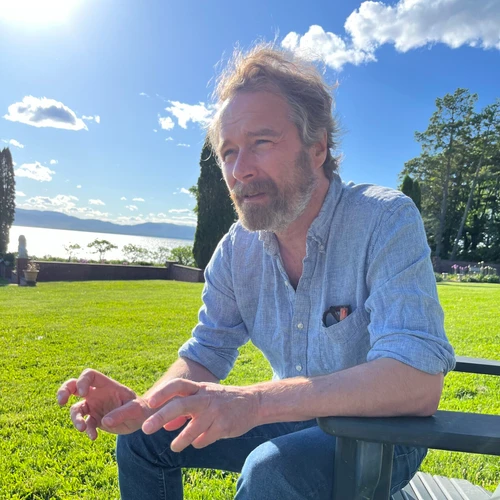
Dan Chiasson is Lorraine C. Wang Professor of English at Wellesley College. He is a poet and critic, and a regular contributor to The New Yorker since 2000. Chiasson also writes regularly about poetry, politics, art, and popular music for The New York Review of Books. He is the author of six books including The Math Campers (Alfred A. Knopf, 2020) and Bernie Sanders: Bernie for Burlington: Politics and Change in One American Place (Alfred A. Knopf, 2026), a book about his hometown and the role it played in shaping the ideas and career of Bernie Sanders. Dan enjoys teaching poetry of all periods, with an emphasis on recent American poets.