How do you bring yourself to the page?
I think that I just love to create, so really just living in the world and reading books and being observational. I think that all writers, in any form, whether a poet or a novelist, or even a comedian, draw on inspiration from observation. So that motivates me. I come up with an idea, or I come across an idea, and I’m like, oh, could this be a poem–let’s think about this some more. And then at some point something in me is just like, run to the page, go play with that, go see if you can make a poem.
What inspires you?
I read a lot of poetry books. I think about books like This Way to the Sugar by Hieu Minh Nguyen. I think about books like Lighthead by Terrance Hayes. I think about books like Pink Elephant by Rachel McKibbens. All sorts of books, even something like The Fire Next Time by James Baldwin, and Their Eyes Were Watching God, by Zora Neale Hurston. Entertainment too–I’m such a fan of stories.
Being in high school and learning about different poets–like Edgar Allen Poe, and metaphor, and just different literary devices–I was like, that’s so cool, I can do this with words, and you know, I’ve been in love ever since. I appreciate moving books that have strong imagery, really good stories. Those are the types of things that tend to stick out to me in writing–if writers are being smart; when I read somebody and go “Oh, you’re doing a smart thing,” I appreciate feeling special because I caught it and I appreciate the great experience.
Why poetry?
I mean, in 2026 there’s so much experimental poetry, and I’m definitely trying to be more experimental in my work–thinking about different shapes and containers for poems. And that’s kind of exciting, and a little bit scary, because I’m stepping out of my comfort zone. I tell the homies that I’m going to write a novel or do some play writing one day. A lot of dialogue starts showing up in my newer work—and I’m like, wait a minute! What’s going on here? Maybe I need to do something with this. I love couplets, I love quatrains, I love tercets, I love a prose poem, and I’m happy to play in that all day, but I’ve seen people work on some wild poems. I remember seeing a visual poem that uses the pictures of human anatomy you might find in a textbook. I was like, Oh shit! I remember reading Terrence Hayes–he has a series of poems that are modeled after a Japanese form of presentation called Pechakucha in 25 line stanzas. I just think that’s the fliest shit ever. It makes me wonder how can I allow for more experimentation in my writing moving forward.The poem doesn’t just have to be couplets and stanzas–it could be–it could be anything. Right now I’m working on a series of poems using business documents as the container–just seeing what I can do with that. There’s so much to do!
But constraint is also interesting–I think poetry just does something with emotion and energy that I find other mediums don’t efficiently. We could probably hit some of the same emotional beats of a poem in a novel, but that’s like 200 to 400 pages long. In a poem, we’re in and out. In one, maybe two pages…you get what I’m trying to say; you feel something. And then we’re done. That’s what draws me to poetry.
Why is poetry important?
Man, poetry is everywhere. I haven’t fact-checked this but, if poetry wasn’t important, why do we think in similes and metaphors? Poetry is doing something. It’s speaking about the human condition. For me, and many poets before me, it’s a way of archiving a moment. It’s a way of speaking truth to power. We can’t exist without that sort of thing. Even when it’s not what we traditionally think of as poetry, there are poets in so many different genres operating different mediums. I think about a musician like Chance the Rapper–that’s an easy one because he came up through poetry. If you listen to his writing, it’s like Oh! This is super poetic. Somebody like a Nick Jenkins is doing the same thing, or even an artist like R.A.P. Ferreira who went to school for philosophy. He’s making hip hop, you know? When I listen to his music, especially his early work, I’m like this is spoken word with an instrumental.
What was your initial idea for Sipèstisyon?
It’s funny because I was just writing poems. I think we’re all just writing poems. I feel like so many of us just run into a book. There are some people who are like, this is the book, I’m gonna create this book from scratch, and these are the poems. But for my book—back in 2015, I had written like a suite of poems about my relationship with my father. I remember writing these poems, and not really thinking much about it. It was a time where there was a shift happening in my writing, so I was more concerned about whether or not these poems were still poems. Before, the poems that I wrote were a little bit dense, and these poems were a little bit more direct and focused. I was very uncertain about whether or not they were still poems. Luckily, I got some confirmation. They told me, “Hey, these are kind of bangers!” and I was like, all right, cool, I’ll start showing them around to literary magazines–I tried to see if anybody was going to publish them. There was a particular magazine that was like “hey, these are beautiful! Are you working on a collection? Because I love how these poems are in conversation with each other.” It was that moment where I was like, I guess these poems are in conversation… That was when I realized that this could be a book. I just kind of started building it from there.
Speak more about that shift in your writing!
When I first started seriously writing poems, you know, I came through spoken word. And like that was super dope–I met so many brilliant minds, and still am very much in that world. I’m taking the year off from slamming because I want to figure out how to be an author, but I definitely have the bug and the itch to go back. When I started out, I remember googling phrases and lines to make sure that they were original. I really did that, and then I was so focused on saying the freshest thing. I was in college at the time, and taking some English classes, and reading literature, so I was trying to make different literary references, too. Those two things combined yielded some really dense work. One of the side effects was a distancing from emotion and an obfuscation of my narrative. While I was busy trying to be fly and original, I kind of forgot my feelings. I was pretty unhealed at the time, too, which didn’t help. When I finally went to a writing retreat, they promptly called my ass out for that. They were like “yeah, we don’t care because you’re hiding from your feelings.” That’s when I started trying to change my approach. I read a chapbook by Nate Marshall called Blood Percussion in 2013 or so. It really got me thinking about writing accessible poems. That’s one of my goals now in this writing journey, I don’t want to write a thing that keeps people at bay. Even if you don’t understand the technicality of the page, I want you to understand the story. I want you to understand the emotional energy. For the poetry nerds, I’m writing for you too, but I want the casual readers to enjoy it.
When do you know a poem is done?
I feel like I’m always tinkering with poems. I’ll spend a day or two drafting, and then I’ll sit with it for a little bit. I’ll go to the open mics and read it, see how it’s resonating with the audience. I’ll bring it to my workshop. I’m in a writing group, and I also just have, in general, trusted readers. I’m always sharing poems with folks just to get a temperature check. There are people that I let tear it apart–this brings me closer to the idea. There are poems in the book that I wrote 10 years ago that I always felt off about. Then I stumbled across them two or three years ago, and thought let’s go back into the world of this poem. Let’s tinker. And then all of a sudden I understood what to do with it, and the next version was leaps and bounds better than the first one.
How does your life inspire your poetry?
I feel like I wrote this collection one poem at a time, and so just letting each moment be what it is. I tried to be as authentic as possible in the stories, and then I let myself be inspired by my cultural background and stuff outside of that too. The book is called sipèstisyon. It’s a Haitian Creole word for superstition. The primary thread of the book is a series of poems called Sipèstisyon. Those poems started off as an attempt to write a series of poems, because at the time I thought it was the flyest shit ever. I still think it’s a super fly. Like so dope, right? But I had never done it successfully. One of my mentors used to say “your writing usually gets interesting at the third idea.” So when I initially wrote about superstitions, I thought How do we make them interesting? Let’s look at this, let’s look at that. Oh wait! You grew up hearing about these superstitions, why don’t you just write about the superstitions that are specific to you–I ended up with a series of poems that felt very unique to me.
That’s how I was able to synthesize things, and I think that those poems helped me create the foundation of the book. I built it on top of that. I think that—well people are still reading this joint, it just came out–but I think that even poems that aren’t explicitly about being Haitian are, somehow, Haitian anyway.
How do you write about trauma and pain?
I wrote this book in two different periods, I wrote this book first, started reporting on it between 2014 and 2017 and then didn’t really resume working on it, like in a real significant way, until 2021. There was a gap where so many things changed for me. I got married, I went to therapy, I was really grappling to understand my childhood trauma and my relationships with my parents–I was figuring out what a healthy family system looks like. All of that informs the poems that came later. This book is about generational trauma, healing, the people that we love who have also hurt us.
Who are you writing for? Who is your audience?
I write poems for me. I love to create. I love language. That’s why I write poems first and foremost. It wasn’t until I was nearly finished with this project, and it had gotten picked up, that I was like oh wait people are going to read these poems! I wasn’t really trying to submit like that. So many people have spent years and years and years shopping around their first book. I got an offer within the first six months of shopping around, and I’m so thankful for it. It was one of my dream presses, and I’m really happy it worked out. But I think when I think about who this book is for? It’s for me! I You know, I hope that other Haitian folks and Caribbean folks in general resonate with the work. I hope that I’m doing some of these stories and experiences justice–so instead of an audience, I just have hopes.
What is your approach to writing about joy?
I feel so fortunate to have been around some great folks in my writing life who showed me what really excellent memoiristic poetry collections could be. You have to make sure that there’s some sort of balance. You can’t wound yourself or re-harm yourself writing these poems. These are lessons that I have heard in passing early on. I was writing this book in a real way–I make serious poems, but IRL I’m a very goofy person–and this is part of the process. I try to allow for moments of silliness and joy to poke through into the writing, and take over the writing. I was putting together this collection and definitely knew there would need to be light. It can’t just be trauma for pages. I needed “true worshippers effectively reaching the kingdom.” I needed “Invocation for the God of Laughter.” I needed that moment with Danny Perkins.
I spent so many years not believing in that poem. I knew that I liked it, but the submission life is tough and it got rejected by so many places for years. I knew this book needed the poem but I was like…is it good enough? And ever since release, so many people tell me that the Danny Perkins poem is great! We love it!
And I think that there’s joy sprinkled throughout the book, but I make a big shift in the third section for light and love. That’s the theme I’m reaching for. The book really needed that. As I get older and do more poetry, and perform, something I’ve thought about is my responsibility as an artist to the audience. I need to make sure that I leave my audience in a good place, or even a neutral place. Like I don’t want to take them to darkness and just pack up, bye-bye, farewell. So I always try to even read goofy poems at the end of my sets. Give them something uplifting. I think that book does that too.
What is your favorite moment in the book?
So the Twerk Poem…I wrote it a while ago, and there was a moment where I was performing it semi-regularly. And it was always so much fun to perform. I was letting myself be silly. The audience loved it and I loved it. That’s something that comes to mind, it’s definitely a favorite moment.
Then there are small victories, going back to older poems that weren’t working. My new eyes and skill set were able to give them different lives. “Invocation for the God of Laughter” is one of those poems. I wrote that back in 2016 and I was like, this is not working! And then I came back in 2022 and I was like oh, this is how you do it. Reading that the poem was resonating with folks was amazing. I love having people who have known me and have watched me grow up see that I’ve tackled them—that I’ve executed at a higher level. They give me props for that, and having those moments is really special. I’m fortunate to live in an area of the country where people really love poems. People who love me and the work that I produce are excited and ready to engage with my book. It’s really big for me and fulfilling. They understand my work and what I’m trying to say. You never know how something is going to land until it’s out there. So to have folks say, “yeah, I see what you’re saying.”
That’s beautiful.
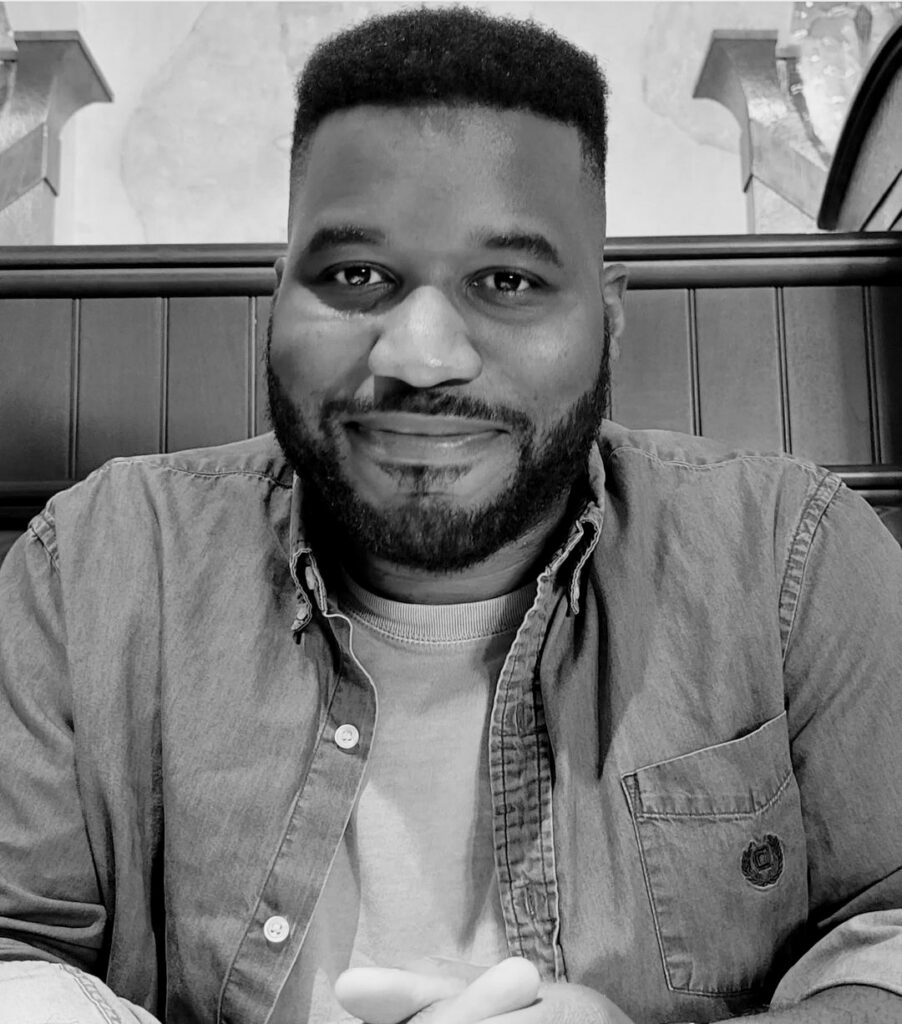
Mckendy Fils-Aimé is a New England based Haitian-American poet, organizer, and teaching artist. He has received fellowships from Callaloo, Cave Canem, The Watering Hole, and Periplus. Over the span of nearly two decades, Mckendy has represented New England in several regional and national poetry slams, performing on numerous semifinal and final stages. Mckendy’s work has been featured or is forthcoming in Best New Poets, Adroit, Muzzle, American Literary Review, the Academy of American Poets, and elsewhere. His debut poetry collection, sipèstisyon, will be published by YesYes Books in 2026.